
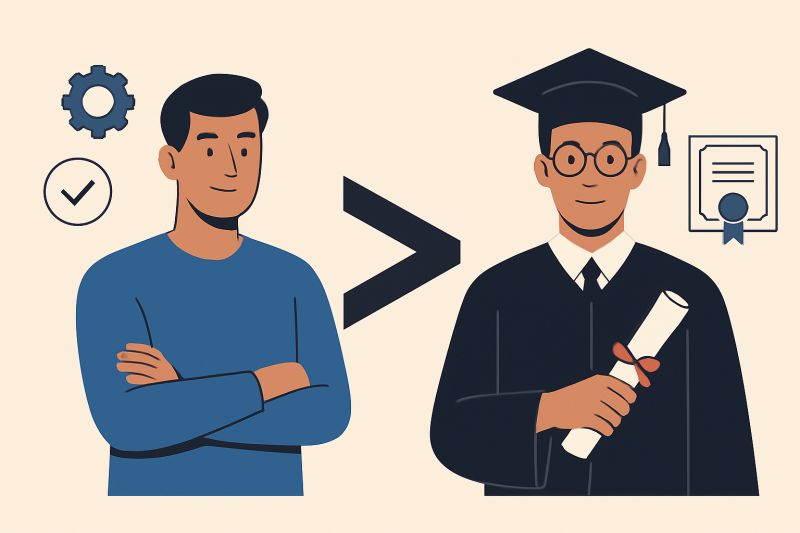
In today’s fast changing world, one question continues to come up again and again: what matters more, your degree or your skills?
For decades, we were told that a good degree guarantees a good future. That belief is now being questioned. The reality, especially in Pakistan, tells a very different story.
We are not facing an unemployment crisis.
We are facing an unemployability crisis.
Every year, thousands of graduates enter the job market with degrees in hand. Yet employers continue to struggle to find candidates who are truly job ready. The gap is clear. Academic knowledge is not translating into practical capability.
A degree may open the door.
But skills determine whether you can stay in the room and grow.
The Shift That Cannot Be Ignored
The world of work has changed. Rapid advancements in technology, artificial intelligence, and automation have redefined what it means to be valuable. Today, the most sought after individuals are not just educated, they are adaptable.
The ability to learn, unlearn, and relearn is no longer optional. It is essential.
At the same time, soft skills that were once considered secondary have now become critical. Communication, problem solving, emotional intelligence, and critical thinking are core competencies. Without them, even the most qualified individuals struggle to perform.
Where Are We Falling Behind
The disconnect lies in how we approach education.
Our institutions are still focused on theory, grades, and exams. Practical exposure, real world problem solving, and industry engagement remain limited. As a result, students graduate with knowledge, but without the confidence or competence to apply it.
This is where the system must evolve.
The Way Forward
If we are serious about preparing our youth for the future, we must act collectively and urgently.
Education must change. Universities need to integrate practical skills into every degree program. Learning should go beyond textbooks and into real world application.
Industry and academia must work together. Internships, live projects, and direct engagement with professionals can bridge the gap between theory and practice.
We must promote a culture of continuous learning. Education does not end with a degree. That is where real learning begins. Professionals must take ownership of their growth through constant upskilling.
Mentorship needs to be prioritized. A mentor can provide direction, clarity, and perspective that no classroom can offer. It is often the missing link between education and employability.
Organizations must also rethink how they hire. Degrees should not be the only filter. Skills, mindset, and the ability to solve real problems should carry greater weight.
The Balance That Matters
This is not a debate of degree versus skills. It is about degree and skills together.
A degree gives you a foundation.
Skills give you momentum.
One without the other is incomplete.
A Call to Action
For students, do not rely only on your degree. Build your skills.
For educators, do not just teach. Prepare.
For employers, do not just hire. Identify potential.
The future belongs to those who are not just qualified, but capable.
Because in the end, success is not defined by what you studied.
It is defined by what you can do and how consistently you can do it.