
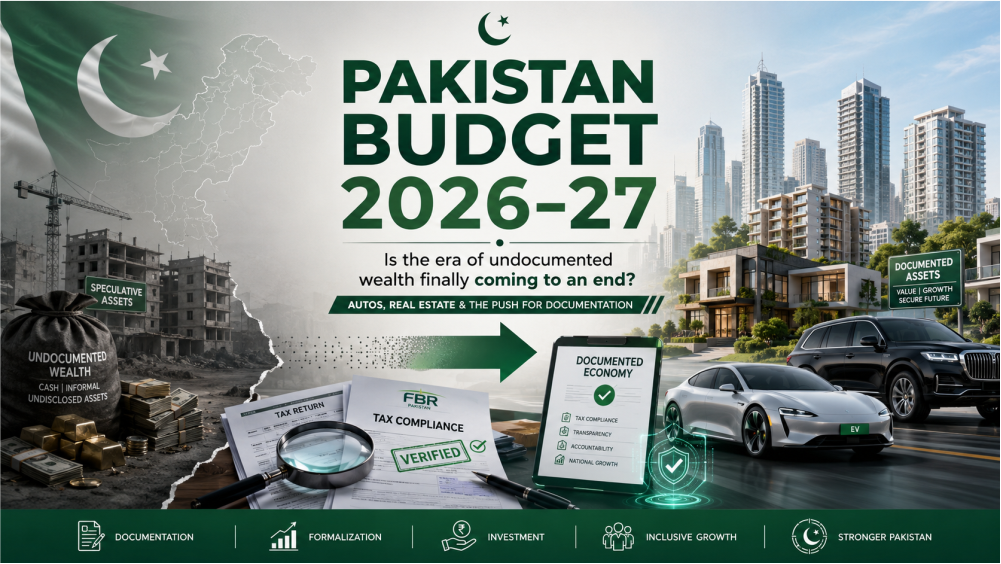
As Pakistan prepares to unveil the Federal Budget 2026–27, the country’s investors, businesses, automobile buyers, and property developers are all asking the same question:
What will change this time?
While the final budget measures remain under wraps, one thing is becoming increasingly clear: Pakistan’s economic managers are under immense pressure to broaden the tax base rather than simply increase taxes on those already paying them.
With the International Monetary Fund’s USD 7 billion Extended Fund Facility (EFF) setting the tone for fiscal discipline, policymakers appear determined to reshape economic behavior by rewarding documentation and penalizing informality.
If current discussions and policy signals translate into budget measures, two sectors are likely to witness some of the most significant changes: automobiles and real estate.
The New Economic Philosophy
For decades, Pakistan’s economy has struggled with a fundamental imbalance.
A relatively small segment of the population pays taxes, while large portions of wealth remain undocumented.
The emerging budget framework appears designed to reverse that trend.
The message from policymakers seems straightforward:
Become a filer. Stay documented. Invest productively.
Those who comply may receive incentives and tax relief. Those who remain outside the formal economy could face increasing restrictions and financial penalties.
The Automobile Sector: A Structural Transformation
Pakistan’s automobile industry has long been influenced by import policies, taxation structures, and consumer affordability.
This year’s budget discussions suggest that the government is preparing a major shift in priorities.
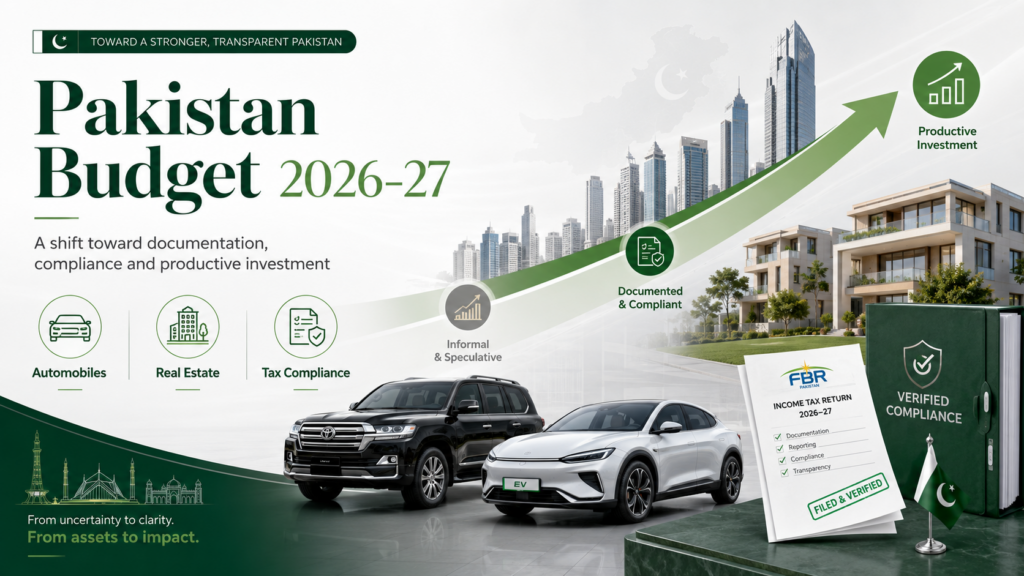
Non-Filers May Face Tougher Restrictions
One of the strongest policy signals emerging from Islamabad revolves around tax compliance.
Industry insiders suggest that vehicle ownership and registration could become increasingly linked to active tax filing status.
Potential measures include:
• Higher withholding taxes for non-filers
• Stricter registration requirements
• Additional scrutiny during vehicle transfers
• Wider tax differentials between filers and non-filers
For many consumers, purchasing a vehicle may soon become not just a financial decision but also a tax compliance decision.
Luxury Vehicles Could Become More Expensive
Another major discussion centers around high-end vehicles.
Reports suggest that cars with engine capacities above 1800cc may face higher Federal Excise Duty (FED) and luxury taxation.
If implemented, luxury SUVs, imported sedans, and premium vehicles could experience significant price increases.
The objective appears twofold:
First, generate additional revenue.
Second, discourage luxury consumption during a period of economic adjustment.
Imported Cars May Face Additional Pressure
Pakistan continues to struggle with foreign exchange constraints.
As a result, policymakers are expected to prioritize local manufacturing over imported finished vehicles.
Industry reports indicate the possibility of:
• Higher customs duties on imported vehicles
• Additional import-related taxation
• Greater incentives for local assembly operations
This would further strengthen the position of domestic assemblers while making imported vehicles less competitive.
Electric Vehicles: The Biggest Winner?
Perhaps the most exciting development lies in the electric vehicle (EV) segment.
Globally, governments are rapidly transitioning toward cleaner transportation systems, and Pakistan appears ready to accelerate its own journey.
Industry proposals currently under discussion include:
• Reduced customs duties on EV components
• Lower taxes on CKD kits
• Incentives for localized EV assembly
• Long-term policy support for electric mobility
If these measures are adopted aggressively, industry experts believe EV prices could fall substantially over the coming years.
The result could be:
• Increased affordability
• Expansion of local EV manufacturing
• Reduced dependence on imported fuel
• Greater environmental sustainability
For investors and consumers alike, the EV sector may emerge as one of the most promising beneficiaries of Budget 2026–27.
Real Estate: Rewarding Filers, Penalizing Speculation
The property sector has historically served as a preferred destination for undocumented capital.
However, that reality may be changing.
The proposed budget direction suggests a clear move toward a two-tier system that heavily favors active tax filers.
Major Relief for Documented Investors
One of the most widely discussed proposals involves substantial reductions in property transaction taxes for filers.
Current discussions suggest:
Property Purchase Tax (Section 236K)
Current: 1.5%
Proposed: 0.25%
Property Sale Tax (Section 236C)
Current: 4.5%
Proposed: 1.5%
If implemented, these changes would dramatically reduce transaction costs.
For example, on a property valued at Rs. 10 million, total transaction taxes could decline from approximately Rs. 600,000 to Rs. 175,000.
That represents potential savings of Rs. 425,000.
Such relief could provide a significant boost to market activity and construction-related industries.
Tougher Environment for Non-Filers
While filers may benefit, non-filers are expected to face increasing pressure.
Possible measures include:
• Higher withholding taxes
• Greater transaction scrutiny
• Wider filer versus non-filer tax gaps
• Enhanced compliance requirements
The objective is clear: make documentation economically attractive and non-compliance increasingly expensive.
Capital Gains Tax to Discourage Speculation
Another area receiving attention is Capital Gains Tax (CGT).
Policymakers appear concerned about speculative property trading that contributes little to productive economic activity.
Under proposals currently being discussed:
• Properties sold within one year may face 15% CGT
• Within two years, 12.5%
• Within three years, 10%
These measures are designed to discourage rapid buying and selling while encouraging long-term investment.
The End of the “File Culture”?
Perhaps the most important shift is not about tax rates at all.
It is about changing investment behavior.
For years, speculative trading of files and undeveloped plots has attracted significant capital.
The new policy direction appears focused on channeling investment toward:
• Apartment developments
• Vertical housing projects
• Constructed properties
• Mortgage-financed housing
• Documented real estate transactions
This transition is particularly important given Pakistan’s estimated housing shortage, which runs into millions of housing units.
Policymakers increasingly view actual construction activity as economically productive, while speculative land trading contributes relatively little to job creation or economic growth.
Winners and Losers
If current proposals become reality, the winners are likely to include:
✓ Active tax filers
✓ Electric vehicle manufacturers
✓ Local automobile assemblers
✓ Apartment developers
✓ Construction companies
✓ Long-term property investors
✓ Mortgage-backed home buyers
Potential losers may include:
✗ Non-filers
✗ Luxury vehicle buyers
✗ Imported car traders
✗ Speculative property investors
✗ Undocumented wealth holders
✗ File and plot trading markets
A Defining Budget
Budget 2026–27 may ultimately be remembered not for how much tax it collected, but for how it attempted to change behavior.
The government appears to be moving beyond simply increasing rates and instead using taxation as a tool to reshape economic incentives.
The broader message emerging from Islamabad is becoming increasingly difficult to ignore:
The future belongs to documented transactions, productive investment, local manufacturing, and tax compliance.
Whether in automobiles or real estate, the age of informal economic activity appears to be facing its most serious challenge yet.
For investors, businesses, and consumers, the question is no longer whether this transition is coming.
The question is whether they are prepared for it.