
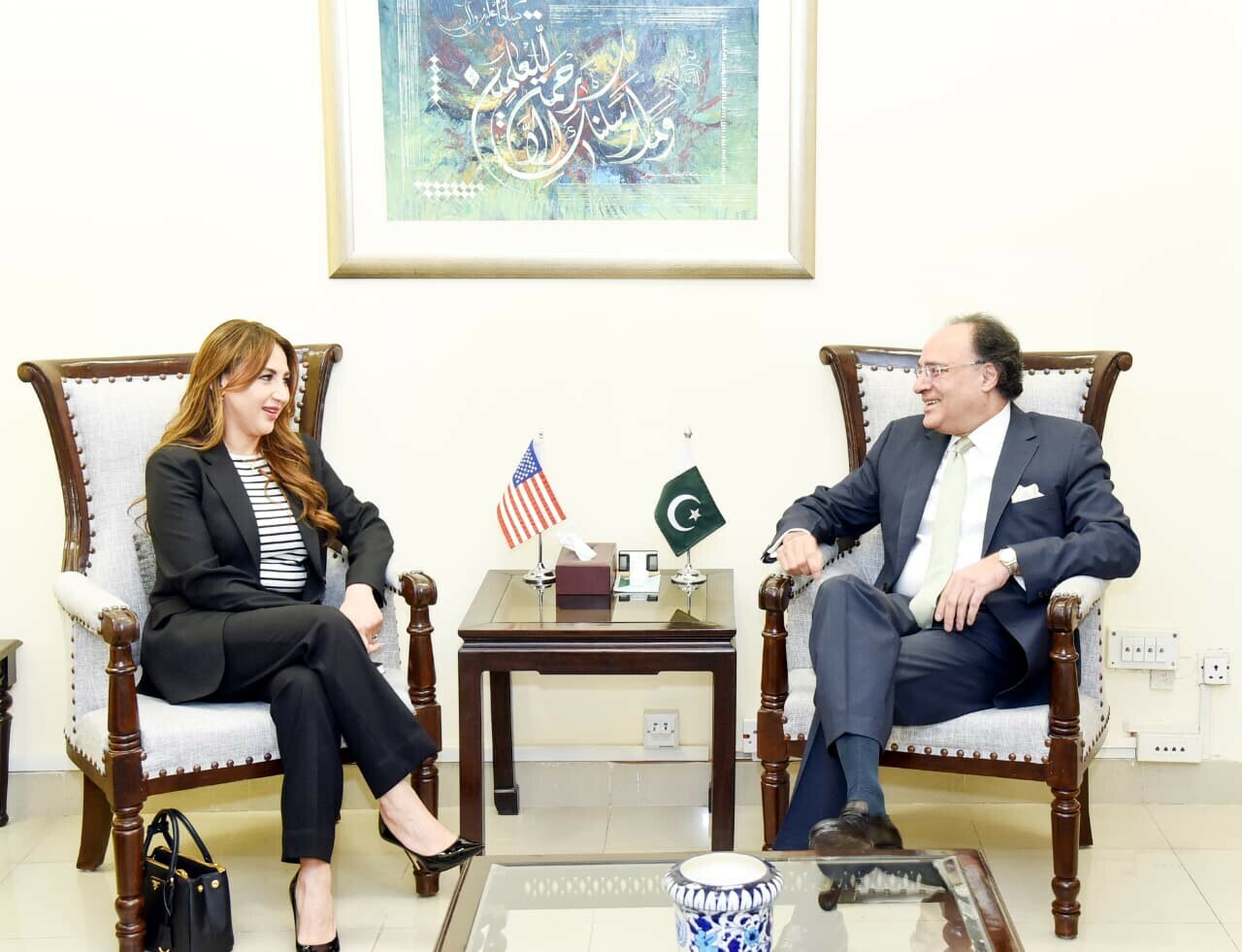
Pakistan and the United States have reaffirmed their commitment to deepening economic cooperation, with both countries agreeing to move forward with a new trade agreement aimed at expanding market access, increasing investment, and promoting collaboration in key sectors.
This development took place during a high-level meeting between Natalie Baker, Chargé d’Affaires of the US Embassy, and Finance Minister Muhammad Aurangzeb at the Finance Division on Friday.
Last month, the US administration implemented a 19 percent reciprocal tariff on a wide range of Pakistani goods, significantly lower than the earlier proposed 29 percent. This revised rate places Pakistan ahead of several regional economies, including India at 50 percent, Bangladesh at 20 percent, Vietnam at 20 percent, and Sri Lanka at 20 percent.
During the meeting, both sides discussed matters of mutual interest, including avenues to enhance bilateral trade, commerce, and US investment in Pakistan.
The finance minister shared that Pakistan’s economy had “turned a corner,” noting that the recent upgrade by Moody’s, which brought all three major international rating agencies in alignment on Pakistan’s economic performance, was a strong indication that the government’s tough but necessary reforms were producing positive results.
Moody’s upgraded Pakistan’s local and foreign currency issuer and senior unsecured debt ratings from Caa2 to Caa1, along with an upgrade of the senior unsecured MTN programme rating from (P)Caa2 to (P)Caa1.
Aurangzeb highlighted that Pakistan’s bold tariff reforms are designed to liberalise trade and steer the country towards export-driven growth. He expressed appreciation to the United States for its ongoing economic and development support, recalling his recent visit to Washington, D.C., where he met US Secretary of Commerce Howard Lutnick and United States Trade Representative Ambassador Jamieson Greer to work towards finalising the trade agreement.
The finance minister emphasised that the agreement would open a new chapter of economic cooperation, particularly in energy, mines and minerals, information technology, cryptocurrency, and other priority sectors. It is expected to enhance market access, attract foreign investment, and strengthen cooperation in areas of shared interest.
He expressed optimism that the agreement would pave the way for increased US investment in Pakistan’s infrastructure, development initiatives, and digital and mining sectors, which are ready for concrete progress.
Natalie Baker described the trade agreement as a significant opportunity for both Pakistan and the US to expand bilateral trade. She noted that American companies were showing strong interest in investment and entrepreneurial ventures in Pakistan, especially in supply chain management, production, project execution, energy, critical minerals, mining, and oil exploration.
The meeting concluded with both countries reaffirming their commitment to work closely to advance these initiatives, ensuring mutually beneficial outcomes and further strengthening trade and economic cooperation.